







Your Nervous System Has 2 Modes — Most People Live in One
Nervous system regulation is one of the most important things your body does — and most people have never thought about it. Right now, as you read this, your autonomic nervous system is running in the background. It controls your heart rate, your digestion, your breathing, your stress response. All without you thinking about it.
Here is the problem: your nervous system has two distinct operating modes. One is designed for action and survival. The other is designed for rest, recovery and repair. In a healthy body, these two modes alternate throughout the day. But modern life has tipped the balance — hard.
Most people spend the majority of their waking hours locked in one mode: sympathetic activation. Fight or flight. The always-on, always-alert state that was designed for short bursts of danger but now runs almost constantly. Deadlines, notifications, caffeine spikes, poor sleep, financial stress — it all adds up. And the body pays the price.
This is not another article telling you to meditate more or take a bath. Instead, we are going to look at what is actually happening inside your nervous system, why it matters more than most health trends, and what you can do — through adaptogens, functional nutrition and daily habits — to help your body find its way back to balance.

The Two Modes of Your Nervous System
Your autonomic nervous system — the part that operates without conscious input — is split into two branches. Think of them as two gears your body shifts between.
Sympathetic: Fight or Flight
The sympathetic nervous system is your accelerator. When activated, it increases your heart rate, sharpens your focus, tenses your muscles and floods your system with cortisol and adrenaline. Blood moves away from your digestive organs and toward your limbs. Your body prepares for action.
This is useful. If you are crossing a busy road or facing a real physical threat, sympathetic activation could save your life. But it was never designed to be your default setting.
Parasympathetic: Rest and Digest
The parasympathetic nervous system is your brake. It slows your heart rate, lowers cortisol, improves digestion and supports immune function. This is where your body repairs tissue, processes nutrients and consolidates memory. It is sometimes called "rest and digest" — and that phrase is more literal than most people realise.
When parasympathetic activity dominates, healing and regeneration happen. Your body digests food properly, detoxifies, builds immunity and restores energy reserves. Without enough time in this mode, recovery stalls.
In a balanced system, these two branches work in rhythm. Sympathetic activation rises when you need it — during exercise, focus or real danger — and falls away when the threat passes, allowing the parasympathetic system to take over.
Why Most People Are Stuck in Sympathetic Mode
Here is the uncomfortable truth: the modern environment is almost perfectly designed to keep your sympathetic nervous system switched on.
Your nervous system cannot tell the difference between a genuine physical threat and a work email marked "urgent." To your brain, stress is stress. And the stimuli never stop.
- Constant connectivity — notifications, news alerts, social media all trigger low-level sympathetic activation throughout the day
- Caffeine overconsumption — excessive coffee stimulates adrenaline and cortisol release, amplifying the fight-or-flight response
- Poor sleep — insufficient rest keeps cortisol elevated and prevents the parasympathetic system from doing its job
- Sedentary stress — sitting at a desk while mentally under pressure creates a mismatch: your body is flooded with stress hormones but has no physical outlet
- Irregular eating — skipping meals or eating on the go keeps your blood sugar unstable, which is another stressor for the nervous system
Over time, this chronic sympathetic dominance becomes the body's default. You stop noticing it because it feels normal. But the effects accumulate — disrupted digestion, shallow sleep, brain fog, weakened immunity, stubborn weight gain, irritability.
The body is not broken. It is responding exactly as it was designed to — just in an environment it was never built for.

What Chronic Stress Actually Does to Your Body
Staying locked in sympathetic mode is not just uncomfortable. It has measurable physiological consequences.
Cortisol Stays Elevated
Cortisol is your primary stress hormone. In short bursts, it is useful — it sharpens focus and mobilises energy. But when cortisol stays elevated for hours or days, it begins to cause problems. It disrupts sleep architecture, promotes fat storage (especially around the midsection), increases inflammation and suppresses immune function.
Digestion Slows or Shuts Down
Your body deprioritises digestion during sympathetic activation. Blood flows away from the gut and toward your muscles. This is why chronic stress often shows up as bloating, indigestion, acid reflux or irregular bowel movements. You might be eating well — but if your nervous system is in fight-or-flight mode, you are not absorbing those nutrients effectively.
Sleep Quality Drops
Falling asleep requires your parasympathetic system to take over. If cortisol is still elevated at bedtime, your body struggles to make that shift. The result: light sleep, frequent waking, and mornings where you feel like you never rested at all.
Cognitive Function Suffers
Sustained sympathetic activation narrows your attention. This is useful in emergencies — you do not need creative thinking when running from danger. But for knowledge work, problem-solving and learning, you need a calmer nervous system. Chronic stress erodes working memory, reduces focus and makes it harder to think clearly.
How to Support Your Parasympathetic Nervous System
The good news: your nervous system is not permanently stuck. It is adaptive. With the right inputs — consistently — you can shift the balance back toward parasympathetic activation. This is not about eliminating stress entirely. That is neither realistic nor desirable. It is about building a body that recovers more efficiently.
1. Rethink Your Relationship with Caffeine
Caffeine is not the enemy. But how most people consume it is a problem. A large black coffee on an empty stomach first thing in the morning spikes cortisol at the exact time it is already naturally elevated. This amplifies sympathetic activation and sets the tone for the rest of the day.
A smarter approach: pair caffeine with compounds that smooth out the stress response. L-theanine, an amino acid found naturally in green tea, has been shown to promote calm alertness by increasing alpha brain wave activity — without reducing the focus-boosting effects of caffeine. It also supports production of calming neurotransmitters like GABA, serotonin and dopamine.
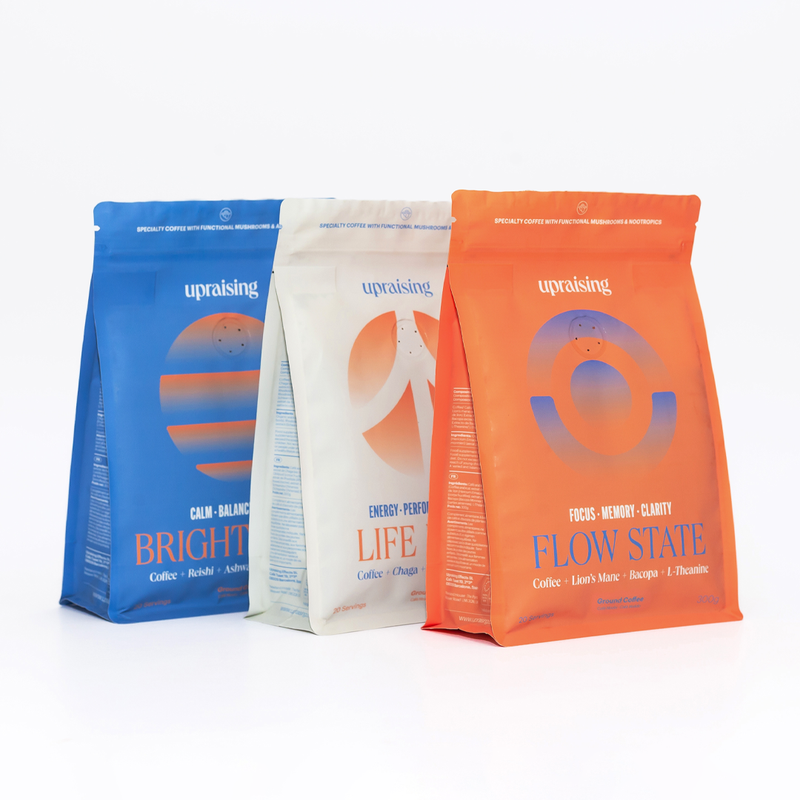
This is one of the reasons Upraising's Flow State Coffee includes L-theanine alongside Lion's Mane and Bacopa Monnieri. The goal is not to remove the energy from coffee, but to remove the nervous system disruption that comes with it.

2. Support Your Stress Response with Adaptogens
Adaptogens are a class of plants and fungi that help your body respond more efficiently to stress. They work primarily by regulating the hypothalamic-pituitary-adrenal (HPA) axis — the system that controls cortisol release. Rather than suppressing your stress response entirely, adaptogens help calibrate it. They support your body in mounting an appropriate response and then returning to baseline more quickly.
Three adaptogens stand out for nervous system support:
- Ashwagandha — one of the most studied adaptogens, shown to lower cortisol levels and support the HPA axis. It is particularly useful in the evening, as it helps reduce the cortisol that keeps you wired at night
- Rhodiola Rosea — helps reduce the over-activation of the HPA axis under physical and mental stress. It supports endurance and helps moderate cortisol spikes without flattening your energy
- Schisandra — a lesser-known adaptogen with antioxidant and anti-inflammatory properties that supports resilience under sustained pressure
Our Bright Mood Coffee combines Ashwagandha and L-theanine with Reishi mushroom — specifically formulated to support calm, balanced energy rather than the jittery spike-and-crash cycle most people associate with coffee.
3. Use Functional Mushrooms for Nervous System Support
Functional mushrooms are not adaptogens in the traditional sense, though some — like Reishi — overlap significantly. What makes them valuable for nervous system regulation is their ability to modulate immune function, reduce inflammation and support the body's recovery systems.
- Reishi — often called the "mushroom of immortality," Reishi is one of the most effective natural supports for the parasympathetic nervous system. It helps lower cortisol, supports sleep quality and promotes a sense of calm. Research suggests it modulates the HPA axis directly, helping to keep the stress response proportionate
- Lion's Mane — best known for cognitive support, Lion's Mane stimulates production of nerve growth factor (NGF) and brain-derived neurotrophic factor (BDNF). These proteins support the growth, maintenance and repair of neurons — essentially helping your nervous system function more effectively at a cellular level
- Chaga — a potent source of antioxidants that helps reduce the oxidative stress caused by chronic sympathetic activation. Think of it as damage control for a nervous system that has been running too hot for too long
If you prefer not to add mushrooms to your coffee, our standalone powders — like Bright Mood+ (Reishi) and Flow State+ (Lion's Mane) — can be mixed into smoothies, shakes or any drink of your choice. No fillers, no artificial flavouring.
4. Build Parasympathetic Habits Into Your Day
Supplements support the process. But the foundation is daily habits that signal safety to your nervous system.
- Eat without distraction. Sitting down, chewing slowly and eating away from screens helps activate the parasympathetic state needed for proper digestion
- Breathe intentionally. Even two minutes of slow, deep breathing (inhale for 4 counts, exhale for 6) activates the vagus nerve — a key parasympathetic pathway
- Move your body. Exercise gives your stress hormones the physical outlet they were designed for. A walk after a stressful meeting can shift your nervous system more effectively than sitting and trying to "calm down"
- Reduce stimulation before bed. Dim lights, limit screens and create a consistent wind-down routine. Your parasympathetic system needs clear signals that the day is ending
None of this is revolutionary. But consistency is what matters. Your nervous system responds to repeated signals, not one-off interventions.
The Role of Nutrition in Nervous System Balance
What you eat — and when — has a direct effect on your autonomic nervous system.
Blood sugar instability is one of the most overlooked drivers of sympathetic activation. When your blood sugar crashes, your body releases cortisol and adrenaline to compensate. This is why you might feel anxious, irritable or unable to focus mid-morning after a sugary breakfast — or no breakfast at all.
Supporting stable blood sugar is one of the simplest ways to keep your nervous system in check:
- Include protein and healthy fats with every meal
- Avoid large doses of refined sugar, especially on an empty stomach
- Eat at regular intervals rather than skipping meals and overeating later
Upraising's Life Force+ — with Chaga, Rhodiola and Schisandra — is designed to provide clean, sustained energy without the blood sugar disruption of typical high-caffeine drinks. Rhodiola in particular supports physical endurance while moderating cortisol, making it a practical choice for people who want energy without the nervous system trade-off.
How to Know If Your Nervous System Is Out of Balance
Most people living in chronic sympathetic dominance do not realise it. It has become their baseline. Here are some signs that your nervous system may be stuck in fight-or-flight mode:
- You feel "tired but wired" — exhausted but unable to fully relax
- Your sleep is light or broken, even when you go to bed early
- You experience digestive issues that do not seem connected to what you eat
- Your jaw, shoulders or lower back are often tense without obvious cause
- You feel on edge, reactive or easily overwhelmed by small things
- You rely on caffeine to get through the day and alcohol or screens to wind down at night
These are not character flaws. They are signals from a nervous system that needs more time in parasympathetic mode. And the solution is not willpower — it is environment, nutrition and consistent daily practices that give your body permission to recover.
Consistency Over Quick Fixes
There is no supplement, breathing exercise or morning routine that will reset your nervous system overnight. Anyone telling you otherwise is selling something.
What actually works is building a daily foundation that supports balance over time. Functional mushrooms and adaptogens can be a meaningful part of that foundation — not as miracle cures, but as tools that support your body's own regulatory systems. Combined with better sleep habits, mindful eating, regular movement and a smarter approach to caffeine, they help create the conditions for your nervous system to do what it already knows how to do: shift between activation and recovery as needed.
Your body has two modes for a reason. The goal is not to eliminate one — it is to stop living exclusively in the other.
Start with small, repeatable changes. Be patient with the process. And give your nervous system the nutritional support it needs to find its rhythm again.