







Gut Health and Focus: The Connection No One Explains
Gut health and focus are more closely linked than most people realise. You have probably experienced it without knowing the cause: a sluggish afternoon where no amount of coffee clears the fog. A morning where your thoughts feel thick and slow, even though you slept well. A pattern of distraction that willpower alone cannot fix.
Most advice around focus targets the brain directly. Meditate more. Sleep better. Try a new productivity app. And while those things matter, they skip over something fundamental: your gut may be the reason your brain is not cooperating.
The gut and the brain are in constant conversation. Scientists call this the gut-brain axis -- a bidirectional communication network that connects your digestive system to your central nervous system. When your gut is out of balance, the signals it sends to your brain become disrupted. That is when brain fog creeps in, focus drops, and mental clarity feels like something that belongs to someone else.
This is not fringe science. Research from institutions like Johns Hopkins and published in journals such as Scientific Reports continues to confirm that the state of your gut microbiome directly influences cognition, mood, and mental performance. Yet the practical implications of this -- what it means for your daily focus and what you can actually do about it -- rarely get explained clearly.
That is what this article is for. We will break down how the gut-brain axis works, why gut imbalances lead to poor focus, and which ingredients and habits genuinely support both systems at once.

What Is the Gut-Brain Axis?
The gut-brain axis is the communication highway between your digestive tract and your brain. It operates through three main channels:
- The vagus nerve -- the longest cranial nerve in your body, running from your brainstem to your abdomen. It carries signals in both directions, allowing your gut to influence your mood, cognition, and stress response.
- Neurotransmitter production -- your gut produces around 90% of your body's serotonin and a significant share of dopamine and GABA. These chemicals regulate mood, motivation, and the ability to concentrate.
- The immune-inflammatory pathway -- around 70% of your immune system lives in your gut. When gut bacteria become imbalanced (a state called dysbiosis), it can trigger low-grade inflammation that reaches the brain.
In simple terms, your gut is not just digesting food. It is manufacturing the chemicals your brain depends on to think clearly, stay calm, and maintain attention.
When this system works well, you probably do not notice it. But when it breaks down -- through poor diet, chronic stress, or disrupted sleep -- the effects show up as scattered thinking, low motivation, and that frustrating sense that your brain is running on half power.
How Gut Imbalances Lead to Brain Fog and Poor Focus
If your gut is inflamed or your microbiome is out of balance, the downstream effects on cognition are real and measurable. Here is what happens:
Disrupted neurotransmitter production
Your gut bacteria produce precursors to serotonin, dopamine, and GABA. When the balance of beneficial bacteria drops -- due to processed food, excess sugar, antibiotics, or chronic stress and high cortisol -- so does your supply of these focus-critical chemicals.
Low serotonin does not just affect mood. It impairs working memory and the ability to sustain attention. Low GABA makes it harder to filter out distractions. Low dopamine reduces motivation and the sense of reward that keeps you engaged in a task.
Increased intestinal permeability
When your gut lining becomes compromised -- sometimes called "leaky gut" -- partially digested food particles and bacterial toxins can enter the bloodstream. This triggers a systemic inflammatory response. Your immune system shifts into a defensive posture, and your brain receives distress signals that manifest as fatigue, confusion, and poor concentration.
Short-chain fatty acid deficiency
Beneficial gut bacteria ferment dietary fibre into short-chain fatty acids (SCFAs) like butyrate, acetate, and propionate. These SCFAs are essential for maintaining the gut barrier, reducing inflammation, and supporting the production of brain-protective compounds. Without enough fibre-rich food, SCFA production drops, and both gut and brain health suffer.
HPA axis dysregulation
The hypothalamic-pituitary-adrenal (HPA) axis is your body's central stress response system. Gut inflammation can dysregulate this axis, leading to elevated cortisol levels. Chronically high cortisol impairs the prefrontal cortex -- the brain region responsible for decision-making, working memory, and sustained focus.
This creates a vicious cycle: stress harms your gut, a damaged gut amplifies your stress response, and the resulting cortisol surge further degrades your ability to concentrate. Breaking the cycle requires addressing both sides -- gut and brain -- simultaneously.
Why Most Focus Advice Misses the Gut
The productivity world is obsessed with optimising the brain in isolation. Better habits. Better tools. Better stimulants. But if your gut microbiome is compromised, these interventions are working against a headwind.
Think of it this way: you would not expect a car to perform well with contaminated fuel, no matter how finely tuned the engine. Your gut is the fuel system. If the inputs are poor or the processing is impaired, brain performance will suffer regardless of what you layer on top.
This is why some people can follow every focus protocol in the book and still feel foggy. The problem is not discipline. It is biochemistry -- and it often starts in the digestive system.
Functional Mushrooms and the Gut-Brain Connection
Functional mushrooms have been used in traditional medicine systems for centuries, but modern research is catching up to explain why they work. Several species have demonstrated a unique ability to support both gut health and cognitive function -- making them especially relevant to the gut-brain axis.
Lion's Mane: the gut-brain bridge

Lion's Mane (Hericium erinaceus) is one of the few natural compounds that operates meaningfully on both sides of the gut-brain axis.
On the brain side: Lion's Mane contains hericenones and erinacines -- bioactive compounds that stimulate the production of nerve growth factor (NGF). NGF is essential for the growth, maintenance, and survival of neurons. Research suggests that Lion's Mane may support neurogenesis -- the creation of new brain cells -- which is linked to improved memory, learning, and focus.
On the gut side: Lion's Mane acts as a prebiotic, feeding beneficial bacteria like Lactobacillus and Bifidobacterium. Its polysaccharides, including beta-glucans, support a healthy and diverse microbiome. A 2021 pilot study found that just seven days of Lion's Mane supplementation improved microbiome diversity and increased the abundance of short-chain fatty acid-producing bacteria in healthy adults.
By supporting both nerve growth in the brain and microbial balance in the gut, Lion's Mane addresses the gut-brain axis from both ends. This dual action is rare and makes it one of the more interesting ingredients in the functional wellness space.
Chaga: gut barrier and immune support

Chaga (Inonotus obliquus) is rich in antioxidants and polysaccharides that support gut barrier integrity. A healthy gut barrier prevents the inflammatory cascade that leads to brain fog. Chaga has also been studied for its ability to regulate the gut microbiome, encouraging the growth of beneficial bacteria while discouraging harmful strains.
For people dealing with low energy alongside poor focus, Chaga offers a relevant combination: gut barrier support, immune modulation, and steady vitality without stimulation.
Reishi: calming the stress-gut loop

Reishi (Ganoderma lucidum) is best known for its calming, adaptogenic properties. But it also plays a role in gut health through its prebiotic polysaccharides, which support beneficial gut bacteria.
More importantly, Reishi helps regulate the stress response. Since chronic stress is one of the primary drivers of gut dysbiosis, keeping the stress-gut loop in check is essential for maintaining both digestive balance and cognitive clarity.
Adaptogens and Nootropics That Support the Gut-Brain Axis
Beyond functional mushrooms, several adaptogens and nootropics have demonstrated benefits for both gut health and cognitive performance.
Ashwagandha

Ashwagandha (Withania somnifera) is one of the most studied adaptogens for stress reduction. It works by modulating the HPA axis, helping to lower cortisol levels. Since elevated cortisol directly damages gut lining and disrupts the microbiome, Ashwagandha's stress-buffering effect has indirect but meaningful benefits for gut health.
Lower cortisol also means better prefrontal cortex function -- so the same mechanism that protects your gut also protects your ability to focus, plan, and think clearly.
L-Theanine

L-Theanine is an amino acid found naturally in green tea. It promotes alpha brain wave activity -- the brain state associated with calm, alert focus. When combined with caffeine, L-Theanine smooths out the stimulant's effects, reducing jitteriness while preserving the cognitive lift.
For the gut, L-Theanine's stress-reducing properties help prevent the cortisol-driven damage that disrupts digestion and microbiome balance. It is a gentle ingredient, but its role in maintaining the calm conditions under which the gut-brain axis functions best should not be underestimated.
Rhodiola Rosea

Rhodiola is an adaptogen with a strong evidence base for reducing mental fatigue and improving cognitive performance under stress. It works partly by modulating cortisol and partly by influencing serotonin and dopamine pathways.
By keeping the stress response in balance, Rhodiola indirectly supports the gut environment. A gut that is not under chronic stress assault is a gut that can maintain its barrier, produce neurotransmitters efficiently, and keep inflammation in check.
Bacopa Monnieri

Bacopa has been used in Ayurvedic medicine for centuries to support memory and learning. Modern research confirms its role in enhancing synaptic communication and supporting antioxidant activity in the brain. Some studies also suggest Bacopa has anti-inflammatory properties in the gut, though more research is needed in this area.
What makes Bacopa particularly useful is its focus on long-term cognitive support rather than acute stimulation. It rewards consistency -- which aligns with how gut health works too. Neither system responds well to quick fixes.
How Upraising Products Fit Into This Picture
Upraising's formulations were not designed around hype. They were built around combinations of ingredients that work together -- and the gut-brain axis is a good example of where that approach pays off.
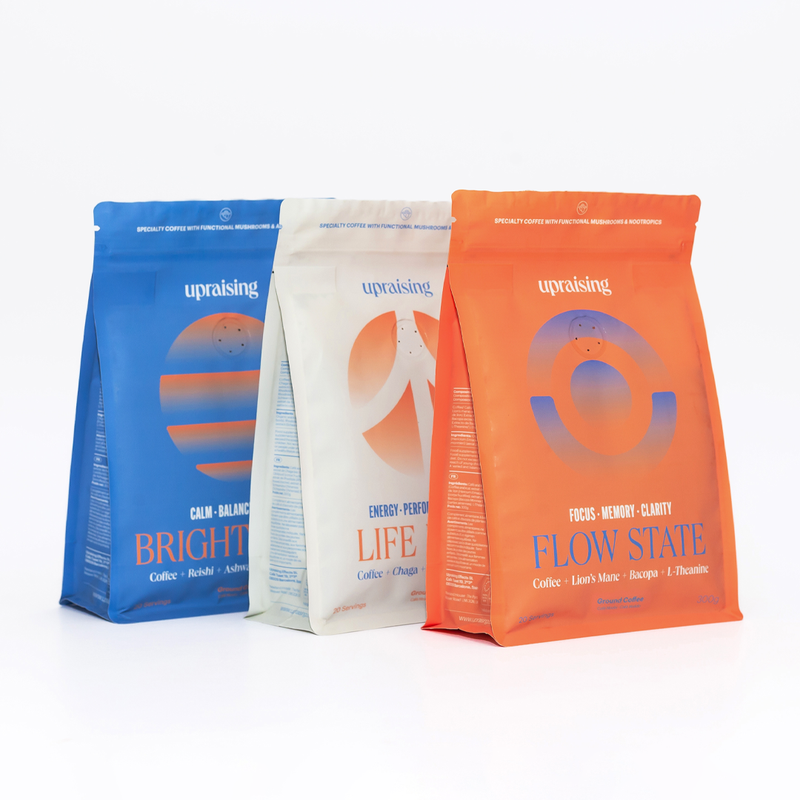
Flow State Coffee combines Lion's Mane (250mg), Bacopa Monnieri (250mg), and L-Theanine (100mg) with 100% arabica coffee. That is a prebiotic mushroom, a traditional cognitive herb, and a calming amino acid -- all in your morning cup. The Lion's Mane supports both gut microbiome diversity and nerve growth factor production. The Bacopa supports sustained cognitive function. The L-Theanine keeps caffeine's effects smooth and reduces the cortisol spike that can come with coffee alone.
Life Force Coffee takes a different angle with Chaga (250mg), Rhodiola (200mg), and Schisandra (200mg). Chaga supports gut barrier integrity and immune function. Rhodiola helps regulate the stress response that can damage the gut. Schisandra has a long history in traditional Chinese medicine for supporting the body's adaptive capacity.
Bright Mood Coffee pairs Reishi (250mg) with Ashwagandha (250mg) and L-Theanine (100mg) -- a combination aimed at calming the stress-gut loop. If your focus problems are rooted in anxiety or an overactive stress response, this blend addresses the upstream cause rather than masking the downstream symptom.
For those who want mushroom support without coffee, the Flow State+ powder delivers Lion's Mane in a versatile format you can add to smoothies, oat milk, or anything else that fits your routine.
None of these are miracle products. They are daily support tools -- designed to give your gut and brain consistent access to functional ingredients that research suggests are genuinely useful.

Daily Habits That Support Both Gut Health and Focus
Ingredients matter, but they work best alongside foundational habits. Here is what the evidence supports:
Eat more fibre
Fibre is the primary fuel for beneficial gut bacteria. Without it, SCFA production drops, gut barrier integrity weakens, and inflammation rises. Aim for a variety of sources: vegetables, legumes, whole grains, nuts, and seeds. Diversity of fibre sources promotes diversity of gut bacteria -- and microbial diversity is consistently linked to better health outcomes.
Manage stress deliberately
Chronic stress is one of the fastest ways to damage your gut. The cortisol it produces weakens the gut lining, shifts the microbiome towards less beneficial species, and disrupts neurotransmitter production. Even simple practices -- a short walk, controlled breathing, consistent sleep times -- can lower cortisol enough to make a measurable difference.
Include fermented foods
Fermented foods like yoghurt, kefir, sauerkraut, kimchi, and miso introduce beneficial bacteria directly into your gut. Regular consumption has been associated with reduced inflammation and improved mood in clinical studies.
Be consistent
The gut microbiome responds to patterns, not one-off interventions. A single serving of kimchi will not transform your gut. A daily habit of diverse, fibre-rich foods alongside functional support will, over weeks and months, shift the balance meaningfully. The same applies to adaptogens and functional mushrooms -- their benefits accumulate with regular use.
Reduce ultra-processed foods
Ultra-processed foods are associated with reduced microbial diversity, increased gut inflammation, and poorer cognitive outcomes. You do not need to be perfect, but shifting the ratio towards whole, minimally processed foods gives your gut bacteria the raw materials they need to support your brain.
The Takeaway
Focus is not purely a brain problem. It is a whole-body problem -- and the gut is a bigger part of the equation than most people realise.
The gut-brain axis is not a metaphor. It is a measurable, biological communication system that determines how well your brain can produce the chemicals it needs to concentrate, stay motivated, and think clearly. When your gut is inflamed, depleted, or imbalanced, your brain feels it -- as fog, distraction, and fatigue.
The good news is that the same habits and ingredients that support gut health also support cognitive performance. Fibre-rich foods. Stress management. Functional mushrooms like Lion's Mane and Chaga. Adaptogens like Ashwagandha and Rhodiola. Nootropics like Bacopa and L-Theanine.
There are no shortcuts here. But there is a clear path: support your gut consistently, and your focus will follow.