







What High Cortisol Actually Feels Like (Most People Miss This)
High cortisol symptoms don't always look like what you'd expect. Most people picture stress as a racing heart, sweaty palms, and a sense of panic. And yes, that can be part of it. But chronically elevated cortisol -- the kind that builds over weeks and months of relentless pressure -- often shows up in ways that have nothing to do with "feeling stressed."
It looks like dragging yourself out of bed despite sleeping eight hours. It looks like craving sugar at 3pm even though you had a proper lunch. It looks like stubborn belly fat that won't shift no matter what you do.
The problem is that these symptoms are so common, so normalised, that most people never connect them back to their stress hormones. They blame willpower. They blame ageing. They blame their diet. And they miss the deeper pattern entirely.
This article breaks down what chronically elevated cortisol actually feels like in daily life, why these signs are so easy to overlook, and what you can do to support healthy cortisol levels naturally.

What Is Cortisol and Why Does It Matter?
Cortisol is your body's primary stress hormone. It's produced by your adrenal glands and plays a role in almost every system -- metabolism, immune function, blood sugar regulation, sleep, and mood.
In short bursts, cortisol is useful. It helps you wake up in the morning, respond to threats, and push through a hard workout. The issue is when cortisol stays elevated for too long.
Chronic stress -- whether from work, poor sleep, overtraining, or just the relentless pace of modern life -- can keep your cortisol output higher than it should be. Over time, this dysregulation affects how you feel, think, and function. And it rarely announces itself with obvious symptoms.
The Subtle Signs of High Cortisol Most People Miss
These are the everyday experiences that most people write off as "just life" -- but that often trace back to cortisol dysregulation.
1. Waking Up at 3am -- Wide Awake for No Reason
One of the most telling signs of cortisol imbalance is waking up between 2am and 4am, alert and unable to fall back asleep. This happens because cortisol naturally dips to its lowest point during the early hours of the night. When your stress response is overactive, your body may release cortisol too early, jolting you awake.
It's not insomnia in the traditional sense. You fall asleep fine. But your body's internal clock is off, and that early-morning cortisol spike disrupts the deepest phase of your sleep cycle.
Over time, this creates a vicious loop. Broken sleep raises cortisol further, which makes the next night's sleep worse. If you're regularly waking in the small hours, it's worth considering whether stress is affecting more than just your energy levels.
2. Feeling "Wired but Tired"
This is the signature paradox of high cortisol. You're exhausted -- bone-deep tired -- but you can't relax. Your body feels heavy, but your mind keeps spinning. You lie in bed drained, yet wired.
This happens because cortisol interacts with your nervous system in a way that keeps you in a low-grade fight-or-flight state. Even when there's no immediate threat, your body acts as if there is. The result is a strange combination of fatigue and restlessness that no amount of caffeine or rest seems to fix.
If this sounds familiar, it's not a character flaw or a caffeine problem. It's a signal that your stress response needs support.
3. Afternoon Energy Crashes
That 2pm to 4pm slump isn't just about lunch. When cortisol is chronically elevated in the morning (to compensate for poor sleep and ongoing stress), it often drops sharply in the afternoon. The result is a crash -- not just tiredness, but a heavy, foggy feeling that makes even simple tasks feel like effort.
Most people reach for sugar or another coffee at this point. But that only creates another spike-and-crash cycle, reinforcing the pattern. A more sustainable approach involves supporting your body's natural energy rhythm rather than overriding it with stimulants.
This is one reason why pairing caffeine with calming compounds like L-Theanine can make a meaningful difference. L-Theanine helps smooth out the stimulant edge while preserving focus -- less spike, less crash.
4. Sugar Cravings That Feel Almost Compulsive
Cortisol directly influences blood sugar. When cortisol is high, your body releases more glucose into your bloodstream to prepare for a "threat." But when no physical threat materialises (because the stress is mental, not physical), insulin sweeps that glucose away. The result? A blood sugar dip that triggers intense cravings for fast energy -- sugar, refined carbs, anything sweet.
This isn't a willpower issue. It's a hormonal one. Your body is genuinely asking for glucose because cortisol has disrupted its normal regulation. Understanding this can help you respond differently -- with blood-sugar-stabilising foods and adaptogens that support metabolic balance -- rather than blaming yourself.
5. Brain Fog and Poor Concentration
Cortisol crosses the blood-brain barrier. When levels stay elevated, it can impair the hippocampus -- the region responsible for memory, learning, and focus. The result is what most people call "brain fog": difficulty concentrating, forgetting words mid-sentence, feeling mentally sluggish even after a good night's sleep.
This is one of the more frustrating symptoms because it affects your work, your conversations, and your confidence. You know you're sharper than this, but you can't seem to access it.
Compounds like Lion's Mane have been studied for their potential to support nerve growth factor (NGF) production in the brain, which may help with cognitive clarity. It's not a fix for chronic stress on its own -- but as part of a broader approach, it can be a useful support.

6. Belly Fat That Won't Shift
You're eating well. You're exercising. But the weight around your midsection won't budge. This is one of the most common -- and most misunderstood -- effects of chronically elevated cortisol.
Your abdomen has roughly four times more cortisol receptors than other fat tissue. When cortisol stays high, it activates enzymes that preferentially store fat in visceral cells around your organs. This isn't about calories in, calories out. It's about hormonal signalling.
Reducing this kind of fat requires addressing the cortisol pattern itself -- not just exercising harder or eating less. In fact, over-exercising with high cortisol can make the problem worse by adding more physical stress to an already overloaded system.
7. Getting Ill More Often
Cortisol suppresses your immune system. In the short term, this is a useful trade-off -- your body deprioritises immune function to focus on the "threat." But when cortisol stays elevated for weeks or months, your immune defences weaken. You pick up every cold. Small cuts take longer to heal. You feel run-down even when you're not technically sick.
If you've noticed you're getting ill more frequently than usual, it may not be bad luck. It may be your body telling you that your stress load has exceeded what it can comfortably manage.
8. Feeling Anxious Without a Clear Reason
Cortisol doesn't just affect your body. It directly influences how your brain processes emotion. Elevated levels can increase activity in the amygdala -- the brain's threat-detection centre -- while reducing activity in the prefrontal cortex, which handles rational thinking.
The result is a background hum of anxiety that doesn't attach to any specific worry. You feel on edge, slightly unsettled, as though something is wrong -- but you can't name what. This low-grade anxiety is often mistaken for a personality trait when it's actually a physiological state driven by your stress hormones.
Why These Symptoms Are So Easy to Miss
The challenge with chronically elevated cortisol is that the symptoms creep in gradually. There's no single dramatic moment -- just a slow erosion of how well you feel.
Most of these signs overlap with things we consider "normal" in a busy life: tiredness, cravings, poor focus, weight gain. We chalk them up to getting older, working too hard, or not being disciplined enough. And because they build slowly, we adjust to them. The new baseline feels normal, even when it's not.
This is also why blood tests don't always tell the full story. A single cortisol reading captures one moment. It doesn't reveal the pattern -- the chronic low-grade elevation that sits just below the clinical threshold but still affects how you feel every day.
What Actually Helps: Supporting Healthy Cortisol Levels
There's no single fix for cortisol dysregulation. It's not a problem you can supplement your way out of without addressing the root causes. But there are things that genuinely help -- and they work best in combination.
Sleep: The Non-Negotiable Foundation
Sleep is when your body resets its cortisol rhythm. Without consistent, quality sleep, every other intervention is less effective. Prioritise a regular bedtime, limit screens in the evening, and keep your room cool and dark.
If falling asleep is the issue, Reishi mushroom has been traditionally used for its calming properties. It supports the parasympathetic nervous system -- the body's natural rest-and-digest mode -- which can help ease the transition into sleep.

Movement -- But the Right Kind
Exercise lowers cortisol -- but only the right kind, at the right intensity. When cortisol is already elevated, high-intensity training can actually make things worse by adding more physical stress.
Walking, yoga, swimming, and strength training at moderate intensity tend to be more supportive. The goal is to move enough to regulate your nervous system without pushing your body further into stress mode.
Adaptogens: Working With Your Stress Response
Adaptogens are a class of plants and mushrooms that help your body adapt to stress more efficiently. They don't eliminate stress -- they help your system respond to it more proportionately, rather than over-reacting.
A few stand out for cortisol support:
 |
Ashwagandha -- one of the most studied adaptogens for cortisol. Research shows it can reduce cortisol levels by 11-30% over 8 weeks of consistent use. It also supports sleep quality, which reinforces the cortisol reset cycle. |
 |
Reishi -- known as the "calm mushroom," Reishi supports the parasympathetic nervous system and has been traditionally used to promote relaxation and restful sleep. |
 |
Lion's Mane -- while not a direct cortisol-lowering agent, Lion's Mane supports nerve growth factor production in the brain, which may help with the cognitive symptoms (brain fog, poor focus) that come with prolonged stress. |
 |
L-Theanine -- an amino acid found naturally in green tea that promotes calm, focused attention without sedation. It works well alongside caffeine to smooth out stimulant effects. |
The key with adaptogens is consistency. They're not like painkillers -- you won't feel a dramatic effect on day one. Most research shows meaningful changes after 4-8 weeks of daily use.
How Upraising Products Fit In
This is where practical application matters. Knowing that ashwagandha and reishi support cortisol is one thing. Actually incorporating them into your daily routine is another.
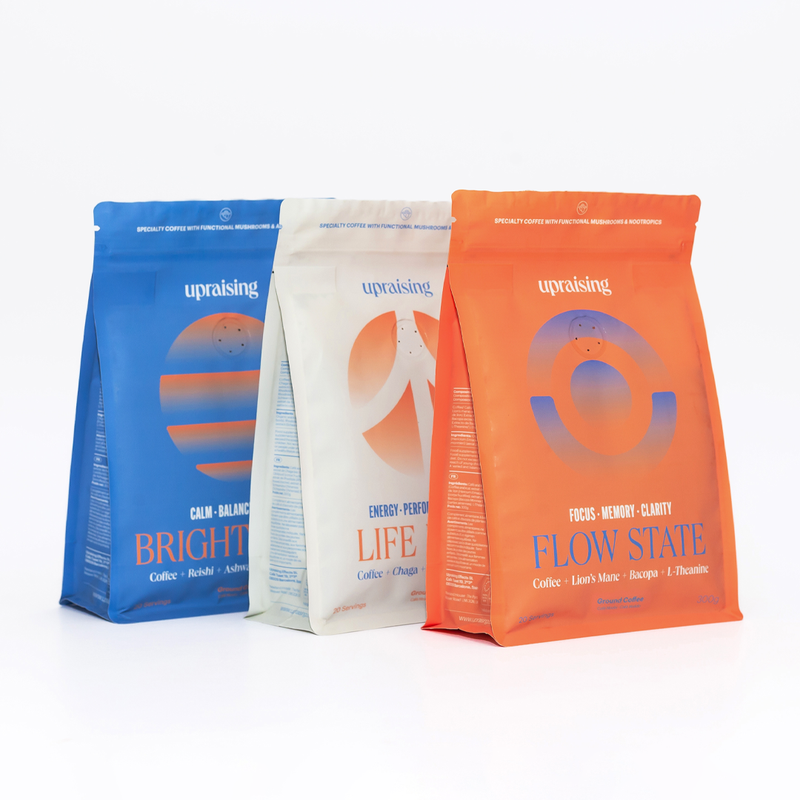
Bright Mood Coffee combines Reishi extract, Ashwagandha extract, and L-Theanine with 100% Arabica coffee. It's designed to give you the alertness of your morning coffee while simultaneously supporting your stress response. No extra steps, no separate supplements -- just your usual morning ritual with functional ingredients built in.
If you don't drink coffee, the Bright Mood+ Powder contains the same active ingredients (Reishi, Ashwagandha, and L-Theanine) and can be mixed into any drink, smoothie, or shake.
For the brain fog and focus issues that often accompany high cortisol, Flow State Coffee pairs Lion's Mane with Bacopa Monnieri and L-Theanine -- a combination targeted at clarity, concentration, and memory support.
And if the main issue is flat, drained energy, Life Force Coffee uses Chaga, Rhodiola, and Schisandra -- adaptogens known for supporting vitality and sustained energy without the crash.
A Realistic Approach to Cortisol Management
It's worth being honest about what this process looks like. You won't "fix" your cortisol in a week. This isn't a detox or a quick reset. Cortisol dysregulation builds over months and years, and it takes time to unwind.
What helps is small, consistent changes. Better sleep habits. Regular, moderate movement. Adaptogens taken daily, not sporadically. And perhaps most importantly, an honest look at the stressors in your life and whether any of them can be reduced or managed differently.
The symptoms described in this article are not things you need to accept as your baseline. They're signals -- your body's way of telling you that something needs to change. The first step is recognising them for what they are.
When to Seek Professional Support
This article focuses on the kind of cortisol elevation that comes from chronic lifestyle stress -- the most common scenario. But it's important to note that significantly elevated cortisol can also be caused by medical conditions such as Cushing's syndrome, pituitary disorders, or certain medications.
If your symptoms are severe, worsening, or accompanied by dramatic physical changes (such as large stretch marks, significant muscle wasting, or rapid weight gain), consult your GP. They can measure your cortisol levels through a blood test, urine sample, or saliva test to rule out underlying medical causes.
For most people, though, the signs discussed here reflect the grey area between "clinically elevated" and "technically normal" -- the zone where you don't have a diagnosis, but you don't feel right either. That's exactly where lifestyle changes and functional support can make the biggest difference.
The Bottom Line
High cortisol doesn't always feel like stress. It often feels like exhaustion, brain fog, stubborn weight, broken sleep, and cravings you can't explain. The reason most people miss it is because these symptoms are so common they seem normal.
They're common, but they're not inevitable. With the right support -- consistent sleep, appropriate movement, adaptogens that work with your stress response, and an honest assessment of your lifestyle -- you can shift the pattern.
It takes time. It takes consistency. But the difference, when it comes, is unmistakable. You sleep through the night. The fog lifts. The cravings ease. And you remember what it feels like to actually have energy -- not the wired, jittery kind, but the steady, grounded kind that lasts.