







The Hidden Link Between Stress and Brain Fog
Stress and brain fog tend to arrive together, but most people treat them as separate problems. You manage the stress with deep breaths or a walk. You fight the fog with another coffee. Neither approach addresses what is actually happening beneath the surface.
Here is the reality: when stress becomes chronic, it changes the way your brain functions. Not in some vague, hand-waving way. There are measurable shifts in hormone levels, neurotransmitter activity and even the structure of brain regions responsible for memory and focus.
That cloudy, sluggish feeling you get after weeks of pressure at work or months of poor sleep is not a character flaw. It is a physiological response. Your brain is not broken. It is overloaded.
Understanding the connection between stress and cognitive function is the first step toward actually doing something about it. Not with a miracle fix, but with consistent, grounded habits and the right nutritional support. This article breaks down what is happening in your body when stress leads to brain fog, why it persists and what you can realistically do about it.
What Is Brain Fog, Exactly?
Brain fog is not a medical diagnosis. It is an umbrella term for a cluster of cognitive symptoms that most people recognise immediately: difficulty concentrating, forgetfulness, mental fatigue and a general sense that your thinking has slowed down.
You might lose your train of thought mid-sentence. Struggle to recall a word you know well. Read the same paragraph three times without absorbing it. These are all signs that your cognitive processing is not firing the way it should.
What makes brain fog frustrating is that it is invisible. You look fine. You can still function. But everything takes more effort than it should and the mental clarity you once had feels just out of reach.
Common Symptoms of Brain Fog
- Difficulty focusing on tasks or conversations
- Short-term memory lapses
- Slower processing speed when making decisions
- Feeling mentally "flat" or detached
- Increased effort needed for routine cognitive tasks
Brain fog can be triggered by many things: poor sleep, nutritional deficiencies, hormonal shifts and illness. But one of the most common and least discussed causes is chronic stress. And the mechanism behind it is more specific than you might think.
How Stress Causes Brain Fog: The Cortisol Connection
When you experience stress, your body releases cortisol. This is useful in short bursts. Cortisol sharpens your alertness, raises your energy and helps you respond to immediate threats. It is part of your survival wiring.
The problem starts when stress does not stop. When cortisol stays elevated for days, weeks, or months, it begins to interfere with the very brain functions it was designed to protect.
Research shows that chronically high cortisol levels can impair the hippocampus, the brain region responsible for memory formation and recall. Over time, elevated cortisol has been linked to reduced volume in the prefrontal cortex, which governs focus, planning and decision-making. If you want to understand more about how cortisol works in your body, our guide on how to lower cortisol naturally is a useful starting point.

What Happens in Your Brain Under Chronic Stress
Cortisol is not the only factor. Chronic stress also triggers neuroinflammation, a low-grade inflammatory response in the brain that disrupts normal signalling between neurons. Think of it as static on the line. The signal is still there, but it is harder to receive clearly.
There is also the concept of cognitive overload. When your mind is constantly processing worry, anticipating problems, or managing emotional tension, there is less bandwidth left for the tasks that require clear thinking. Your brain is not failing. It is simply using its resources elsewhere.
- Hippocampus impairment: Reduced ability to form and retrieve memories
- Prefrontal cortex disruption: Weakened focus, planning and decision-making
- Neuroinflammation: Slower neural signalling and reduced mental clarity
- Neurotransmitter imbalance: Changes in serotonin and dopamine that affect mood and motivation
This is why brain fog often feels worse during periods of sustained pressure, even when you are technically getting enough sleep and eating well. The stress itself is the drain.
Why Brain Fog Gets Worse Over Time
One of the most unhelpful things about stress-related brain fog is that it tends to compound. You feel foggy, so you make mistakes. The mistakes create more stress. The additional stress deepens the fog. It becomes a feedback loop that is difficult to interrupt without deliberate action.
Chronic stress also affects your sleep quality, even if you are getting enough hours. Elevated cortisol can suppress deep sleep and REM sleep, both of which are essential for memory consolidation and cognitive recovery. You wake up feeling unrested, which feeds directly back into the fog.
There is a metabolic dimension too. Stress shifts your body toward survival mode, altering how you process energy and nutrients. If you are curious about this connection, the article on how stress affects your metabolism goes deeper into the science behind it.
Over months and years, this pattern can start to feel normal. Many people do not even realise they are experiencing brain fog because they have forgotten what clarity feels like. That normalisation is part of what makes chronic stress so quietly damaging.
Adaptogens for Brain Fog: How They Work
Adaptogens are a class of plants and herbs that help your body regulate its stress response. They do not eliminate stress. Instead, they support your endocrine system in managing cortisol more effectively, helping to bring your stress hormones closer to balance.
This matters for brain fog because much of the cognitive disruption comes from cortisol dysregulation. When cortisol is too high, your thinking slows. When it is too low, from prolonged burnout, you feel flat and unmotivated. Adaptogens work in both directions, raising what is low and lowering what is high. That balancing effect is what sets them apart from stimulants or sedatives.
Key Adaptogens That Support Cognitive Function

Lion's Mane is a functional mushroom with a growing body of research behind it. It contains compounds called hericenones and erinacines, which stimulate the production of nerve growth factor (NGF). NGF supports the maintenance and regeneration of neurons, which is directly relevant to memory and focus. Lion's Mane does not work overnight, but with consistent use, it may help support the neural pathways that stress has been quietly wearing down.

Ashwagandha is one of the most studied adaptogens for stress and cognition. It has been shown to reduce cortisol levels in clinical trials and is traditionally used to support calm, focused energy. For people whose brain fog is rooted in anxiety or chronic tension, ashwagandha addresses the source rather than masking the symptom.

Rhodiola Rosea is an adaptogen with particular relevance to mental fatigue. In placebo-controlled studies, rhodiola has been shown to improve attention and reduce fatigue during periods of decreased performance caused by stress. It is especially useful for those who feel cognitively depleted rather than anxious. You can learn more about how adaptogens support different aspects of your health in our dedicated guide.

Bacopa Monnieri is a nootropic herb used in Ayurvedic medicine for centuries. Research shows it can improve word recall, attention and memory, while also reducing anxiety. It works by supporting acetylcholine activity, a neurotransmitter critical for learning and memory formation.
Nootropics vs. Adaptogens: A Quick Distinction
Adaptogens regulate your stress response. Nootropics directly enhance cognitive function. Some ingredients, like Bacopa, do both. The most effective approach to stress-related brain fog often combines the two: adaptogens to address the root cause (cortisol dysregulation) and nootropics to support the brain functions that have been affected.
Practical Steps to Clear Brain Fog From Stress
There is no single fix for stress-related brain fog. It requires a combination of lifestyle adjustments and, where helpful, targeted nutritional support. Here is what the evidence points toward.
1. Address Your Sleep
Sleep is where your brain consolidates memories and clears metabolic waste. Without quality sleep, no supplement or habit change will fully resolve brain fog. Aim for seven to nine hours per night, with a consistent sleep and wake time. Reducing screen exposure in the evening and keeping your room cool can make a meaningful difference.
2. Move Your Body Daily
Physical activity reduces cortisol, increases blood flow to the brain and stimulates the release of brain-derived neurotrophic factor (BDNF), which supports neural health. Even thirty minutes of moderate movement, such as walking, cycling, or swimming, can improve cognitive function over time.
3. Rethink Your Caffeine Habits
Standard coffee gives you a short-term focus boost, but it also raises cortisol. For people already dealing with chronic stress, this can make brain fog worse in the long run. The crash after caffeine wears off often mimics or amplifies the very symptoms you were trying to fix.

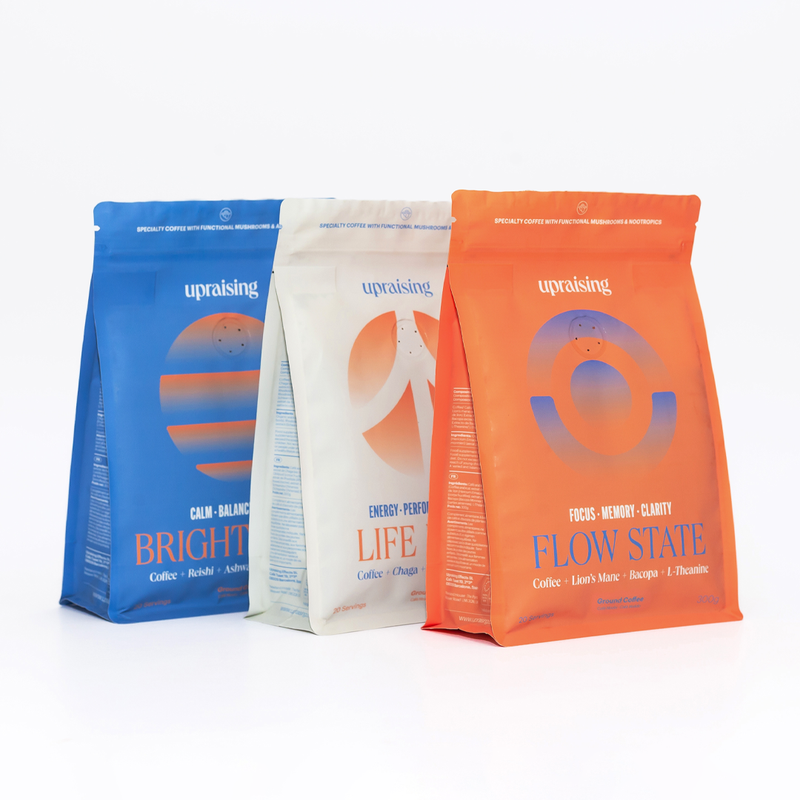
This is where functional coffee can be genuinely useful. Flow State Coffee combines 100% Colombian arabica with Lion's Mane, Bacopa Monnieri and L-Theanine. The L-Theanine smooths out the caffeine response, reducing the jittery spike and crash, while the Lion's Mane and Bacopa provide longer-term cognitive support.
If your brain fog is more closely tied to anxiety or emotional stress, Bright Mood Coffee pairs the same arabica base with Reishi and Ashwagandha, both of which help regulate cortisol and support a calmer mental state. You can read more about what to expect from Reishi in this guide.
4. Build in Mental Recovery
Your brain needs downtime. Not just sleep, but waking rest. Short breaks during the workday, time spent without screens and practices like meditation or breathwork all give your prefrontal cortex a chance to recover. This is not a luxury. It is maintenance.
5. Support Your Brain With the Right Nutrients
Beyond adaptogens, certain nutrients play a direct role in cognitive function. Omega-3 fatty acids support the integrity of brain cell membranes. B vitamins are essential for neurotransmitter production. Antioxidants help combat the oxidative stress that chronic cortisol exposure generates.
If you do not drink coffee, the same functional ingredients are available in powder form. Flow State+ Powder delivers organic Lion's Mane, Bacopa and L-Theanine in a format you can add to any drink, smoothie, or food.
When Brain Fog Might Be Something Else
It is worth noting that not all brain fog is caused by stress. Thyroid conditions, iron deficiency, blood sugar dysregulation and hormonal changes can all produce similar symptoms. If your brain fog is persistent and does not improve with lifestyle changes, it is worth speaking to a healthcare professional to rule out underlying causes.
Stress-related brain fog tends to follow a pattern: it worsens during high-pressure periods, improves during rest and is accompanied by other stress symptoms like tension, poor sleep, or irritability. If that matches your experience, the approaches outlined here are a reasonable place to start.
Consistency Over Quick Fixes
The relationship between stress and brain fog did not develop overnight and it will not resolve overnight either. Adaptogens like Lion's Mane and Ashwagandha work best with consistent, daily use over weeks and months. The same is true for sleep hygiene, exercise and stress management practices.
There is no supplement that replaces good habits. But there are ingredients backed by real research that can support your brain while you build those habits. The goal is not to feel sharp tomorrow. It is to create conditions where clarity becomes your baseline again.
If stress has been quietly eroding your ability to think, remember and focus, that is not something to push through. It is something to address. Start with one change. Be patient. And give your brain the support it has been asking for.