






From Reishi to Chaga: How to Choose the Right Mushroom for Your Goal
Functional mushrooms are everywhere right now. Reishi in your latte. Lion's mane in your supplement stack. Chaga in your morning coffee. But here is the problem: most people pick one based on what sounds good on a label — not based on what they actually need.
That is a missed opportunity. Because each functional mushroom does something genuinely different. They contain distinct bioactive compounds, support different systems in the body, and work best when matched to a specific goal.
This guide breaks it down plainly. No hype. No miracle claims. Just a clear look at the most well-researched functional mushrooms, what the evidence says they do, and how to choose the right one for your situation — whether that is better sleep, sharper focus, more sustained energy, or stronger immune resilience.
What Are Functional Mushrooms — and Why Do They Work?
Functional mushrooms are species that have been used in traditional medicine for centuries — particularly in Chinese, Japanese, and Siberian herbal traditions. Unlike culinary mushrooms you might toss into a stir-fry, these are valued for their bioactive compounds rather than their flavour.
The key compounds include:
- Beta-glucans — polysaccharides that interact with immune cells and support immune regulation
- Triterpenes — compounds with anti-inflammatory and adaptogenic properties, found especially in reishi
- Hericenones and erinacines — unique to lion's mane, these stimulate nerve growth factor (NGF) production in the brain
- Melanin and polyphenols — concentrated in chaga, providing potent antioxidant protection
Many functional mushrooms also act as adaptogens — meaning they help the body regulate its stress response rather than simply suppressing or stimulating a single pathway. This is what separates them from most supplements. They support balance, not just a boost.
That said, not all mushrooms are adaptogens, and not all adaptogens are mushrooms. The distinction matters. Understanding which compounds are present in which species is how you move from guessing to choosing deliberately.
Reishi: The Mushroom for Calm, Sleep, and Stress Recovery

If your primary goal is to wind down, manage stress, or improve sleep quality, reishi (Ganoderma lucidum) is the mushroom most worth your attention.
Reishi has been called the "mushroom of immortality" in traditional Chinese medicine — a dramatic name, but the research behind it is more measured and more interesting. Its triterpene content is what sets it apart. These compounds interact with the nervous system in ways that support the parasympathetic "rest and digest" response, which is the opposite of your fight-or-flight mode.
What the Research Suggests
- Reishi may help modulate the HPA axis — the system that governs your cortisol output and overall stress response
- Some studies suggest reishi supports sleep onset and sleep quality, particularly for people dealing with chronic stress or restlessness
- Its beta-glucans also provide immune-modulating benefits, making it a dual-purpose mushroom for stress and resilience
Who Should Consider Reishi
People who feel wired at night. People whose stress sits in their body — tight shoulders, racing thoughts, difficulty switching off. People who want a gentler wind-down ritual that does not involve melatonin or sedatives.
Reishi works well when paired with ashwagandha, another adaptogen known for its cortisol-modulating properties. Together, they support a calmer baseline — not sedation, just a quieter nervous system.
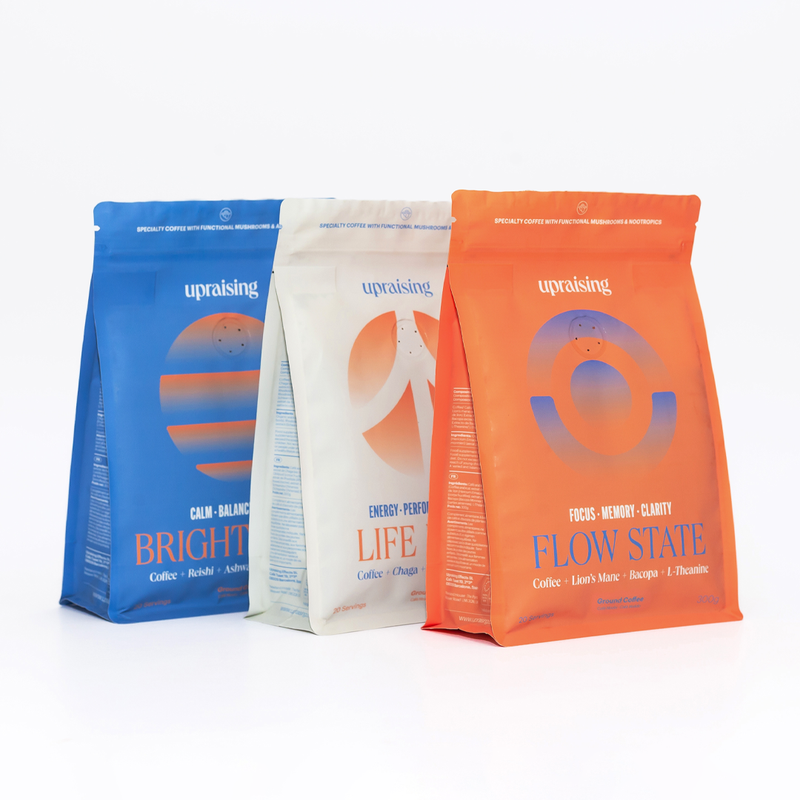
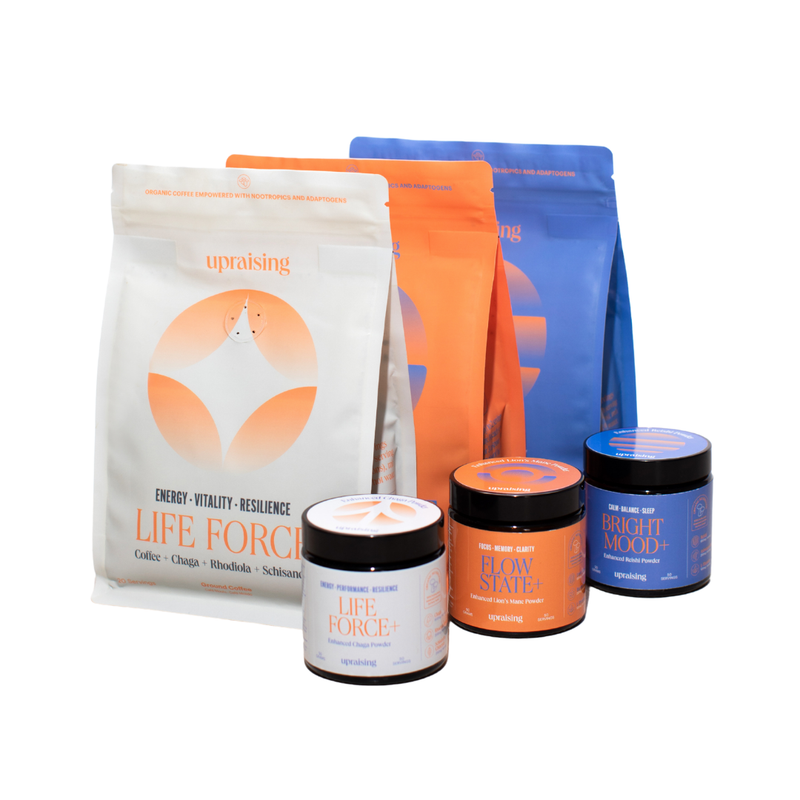
Upraising's Bright Mood+ powder combines reishi extract (65%) with ashwagandha and L-theanine — designed specifically for mood support and better sleep quality. Mix it into an evening tea or a pre-bed smoothie and give it a few weeks to build up.

Lion's Mane: The Mushroom for Focus, Memory, and Cognitive Clarity

If your goal is sharper thinking — whether for work, study, or simply feeling mentally present — lion's mane (Hericium erinaceus) is where the evidence is strongest.
Lion's mane is unique among functional mushrooms because of its specific action on the brain. It contains two compound families — hericenones and erinacines — that stimulate the production of nerve growth factor (NGF) and brain-derived neurotrophic factor (BDNF). These are proteins your brain uses to grow, maintain, and repair neurons.
What the Research Suggests
- Lion's mane has shown promise in studies for improving cognitive function, particularly in adults experiencing mild cognitive decline
- A 2023 study found that lion's mane extract improved hippocampal memory in mice by enhancing neurite outgrowth — the formation of new neuronal connections
- Some research suggests it may support mood regulation by reducing inflammation in the brain, which is increasingly linked to anxiety and depressive symptoms
Who Should Consider Lion's Mane
People who need sustained focus for knowledge work. Students preparing for exams. Anyone who notices their memory is not what it used to be. People dealing with brain fog — that sluggish, scattered feeling that makes simple tasks feel effortful.
Lion's mane pairs particularly well with L-theanine and caffeine. The caffeine provides alertness, the L-theanine smooths out the jitters and promotes calm focus, and the lion's mane supports the underlying neurobiology of attention and recall.
This is exactly the logic behind Upraising's Flow State Coffee — 100% Colombian arabica blended with lion's mane, bacopa monnieri, and L-theanine. It is designed for focus without the crash. If you prefer your mushrooms without coffee, the Flow State+ powder delivers the same trio of nootropics in a form you can add to any drink.

Chaga: The Mushroom for Immunity, Vitality, and Antioxidant Defence

Chaga (Inonotus obliquus) looks nothing like a typical mushroom. It grows as a dark, dense mass on birch trees in cold climates — particularly in Finland, Siberia, and northern Canada. And its appearance hints at what makes it special: chaga is one of the most antioxidant-rich foods ever tested.
Its ORAC score (a measure of antioxidant capacity) ranks higher than acai, blueberries, and dark chocolate. That is not a marketing stat — it is a measurable reflection of the melanin, polyphenols, and superoxide dismutase (SOD) it contains.
What the Research Suggests
- Chaga's beta-glucans support immune cell activity, helping the body mount an appropriate response to infection without tipping into over-reaction
- Its antioxidant profile helps neutralise free radicals — unstable molecules that cause oxidative stress and accelerate cellular ageing
- Some research points to anti-inflammatory effects, particularly in the gut, which has downstream implications for metabolic health
Who Should Consider Chaga
People who want to support their immune system — particularly during seasonal transitions or periods of high physical demand. People interested in longevity and cellular protection. Athletes or active individuals looking for recovery support alongside their training.
Chaga works well alongside rhodiola and schisandra — two adaptogens known for supporting physical endurance and resilience. Together, they address both the oxidative stress of hard training and the hormonal stress it creates.
Upraising's Life Force+ Coffee combines chaga extract with rhodiola rosea and schisandra chinensis in a smooth Colombian arabica base. It is built for energy and vitality — the kind that comes from cellular health, not stimulation.

How to Choose the Right Mushroom for Your Goal
Here is the practical framework. Match your primary goal to the mushroom with the strongest evidence for that outcome:
- Better sleep and stress management — Reishi, ideally paired with ashwagandha
- Sharper focus and cognitive clarity — Lion's mane, ideally paired with L-theanine and bacopa
- Immune support and antioxidant protection — Chaga for added immune depth
- Physical energy and endurance — Rhodiola for adaptogenic resilience
A few things worth noting:
You Do Not Have to Pick Just One
Many people use two or three functional mushrooms together — sometimes called "stacking." This is sensible as long as each one serves a distinct purpose. Taking reishi in the evening for sleep and lion's mane in the morning for focus is a common and well-reasoned approach.
Quality Matters More Than Quantity
Not all mushroom products are equal. Look for:
- Fruiting body extracts — not mycelium grown on grain, which often contains starch filler and fewer bioactive compounds
- Standardised beta-glucan content — this tells you the product has been tested for its active compounds
- Transparent sourcing — knowing where the mushrooms are grown and how they are processed. Upraising sources its mushrooms from Finland, with full traceability from spore to shipment
- No fillers, no artificial flavouring — if the ingredient list includes anything you cannot pronounce, that is a signal
Consistency Beats Intensity
Functional mushrooms are not like caffeine. You will not feel a dramatic effect after one dose. Their benefits build over weeks of consistent use — typically two to four weeks before you notice meaningful changes. This is because they work on underlying biological systems (immune regulation, nerve growth, stress adaptation) rather than providing an immediate stimulant effect.
If you are wondering what to expect when you start taking mushrooms, the honest answer is: not much at first. And that is actually a good sign. It means the changes are happening at a foundational level.
Building a Daily Mushroom Routine
Once you have identified your goal, the next step is making it habitual. The easiest way to do that is to attach your mushroom intake to something you already do every day.
Morning: Focus and Energy
If you drink coffee, this is the simplest integration point. Flow State Coffee gives you lion's mane, bacopa, and L-theanine alongside your caffeine — no extra steps required. If you prefer energy and vitality, Life Force Coffee delivers chaga with rhodiola and schisandra.
If you do not drink coffee, the enhanced powders mix easily into a smoothie, tea, or even plain water. One to two grams daily is the recommended serving — roughly half a teaspoon.
Evening: Calm and Recovery
Reishi is best taken in the evening, when its calming properties align with your body's natural wind-down. Bright Mood+ mixed into a warm drink an hour or two before bed can become a quiet signal to your nervous system that it is time to shift gears.
Stacking Across the Day
A well-structured daily stack might look like this:
- Morning — Flow State Coffee (lion's mane + bacopa + L-theanine) for focus
- Midday — Life Force+ powder (chaga + rhodiola + schisandra) in a smoothie for sustained energy
- Evening — Bright Mood+ powder (reishi + ashwagandha + L-theanine) in herbal tea for calm and sleep
That covers focus, energy, immunity, and sleep recovery — using three products across the day, each matched to when they are most useful.

Common Myths Worth Addressing
Before you start, it helps to clear up a few common misconceptions about functional mushrooms:
- "They work instantly." They do not. Expect two to four weeks of consistent use before noticing changes.
- "More is better." Not necessarily. Follow recommended dosages. These compounds are potent at small amounts.
- "All mushroom supplements are the same." They are not. Mycelium-on-grain products contain significantly fewer bioactive compounds than fruiting body extracts.
- "They replace medication." They do not. Functional mushrooms are a complement to a healthy lifestyle — not a replacement for medical advice or prescribed treatment.
The Bottom Line
Choosing the right functional mushroom is not complicated. It starts with one question: what do you actually need support with right now?
If it is sleep and stress — start with reishi. If it is focus and mental clarity — start with lion's mane. If it is energy and immune resilience — start with chaga.
Then find a high-quality source, make it part of your daily routine, and give it time. Functional mushrooms are not a quick fix. They are a long game — and the evidence suggests the long game is worth playing.
The real shift is not about finding a perfect product. It is about building a consistent practice that supports how you want to feel — day after day, week after week.