







What is Cognitive Longevity and How to Support It Naturally
Cognitive longevity means keeping your mind sharp, clear, and capable — not just in your thirties, but across your entire life. It is not about avoiding dementia as a worst case. It is about actively building and maintaining a brain that works well for as long as possible.
Most people think about their physical health as something to invest in over time. Their brain, less so. But the same principle applies: what you do consistently today shapes what your mind is capable of decades from now.
This is not a fringe concept. The science of brain ageing has advanced significantly over the past decade. Researchers now understand that cognitive decline is not inevitable — and that lifestyle, nutrition, and targeted supplementation all play a measurable role in how well the brain holds up over time.
This guide covers what cognitive longevity actually means, the biological mechanisms behind it, and the evidence-based strategies — from sleep and exercise to adaptogens and nootropics — that support it.
What Does Cognitive Longevity Actually Mean?
Cognitive longevity refers to the preservation of mental function — memory, focus, processing speed, language, and executive function — across the lifespan. It is sometimes described as "mindspan": how long your mind stays genuinely present and capable, not just your body.
It sits within the broader field of longevity science, which distinguishes between lifespan (how long you live) and healthspan (how well you live). Cognitive longevity is about extending your mental healthspan — staying sharp into later life, not just staying alive.
The research base here is real. Studies from Cambridge's Centre for Ageing and Neuroscience confirm that the brain retains a degree of plasticity — the ability to adapt and reorganise — well into older age. The question is not whether this is possible. It is what conditions allow it to happen.

The Biology: What Happens to the Brain as it Ages?
Understanding what drives cognitive decline makes it easier to understand what slows it down. A few key mechanisms are worth knowing:
Neuroinflammation
Chronic low-grade inflammation is one of the most consistent findings in brains that age poorly. Neuroinflammation disrupts communication between neurons, impairs memory consolidation, and accelerates the accumulation of cellular damage over time.
Diet, sleep deprivation, chronic stress, and sedentary behaviour all drive neuroinflammation. Reducing these inputs is one of the most effective things you can do for long-term brain health.
Declining BDNF
Brain-derived neurotrophic factor — BDNF — is a protein that supports the survival, growth, and maintenance of neurons. Think of it as fertiliser for the brain. Higher BDNF levels are consistently associated with better memory, faster learning, and a lower risk of neurodegenerative disease.
BDNF naturally declines with age. But lifestyle choices — particularly exercise and certain dietary compounds — can meaningfully reverse this trend.
Mitochondrial Dysfunction
Neurons are energetically demanding cells. They rely on healthy mitochondria to produce the ATP (cellular energy) needed to function. As mitochondria become less efficient with age, neurons struggle to fire correctly, and cognitive performance suffers.
Supporting mitochondrial health — through diet, movement, and targeted nutrition — directly supports the brain's capacity to work well long-term.
Beta-Amyloid Accumulation
Beta-amyloid plaques — abnormal protein deposits — are associated with Alzheimer's disease and cognitive decline. The brain has a natural clearance system for these compounds, which operates primarily during deep sleep. Poor sleep is one of the strongest modifiable risk factors for long-term cognitive decline.
Lifestyle Strategies That Support Cognitive Longevity
The research is clear that lifestyle is the single biggest lever for long-term brain health. Not supplements alone, not genetics alone — but the daily habits you build and maintain. Here is what the evidence consistently points to.
Exercise: The Most Reliable Cognitive Investment
Physical activity is the most well-evidenced intervention for long-term brain health. It increases BDNF, improves hippocampal volume (a brain region central to memory), reduces neuroinflammation, and supports mitochondrial efficiency in neurons.
You do not need to train like an athlete. Consistent moderate aerobic activity — brisk walking, cycling, swimming — produces measurable cognitive benefit. Resistance training adds further protection, particularly for executive function and processing speed.
- Aim for 150 minutes of moderate aerobic activity per week
- Include at least two resistance training sessions
- Even short bouts of movement throughout the day reduce sedentary risk
Sleep: The Brain's Maintenance Window
During deep sleep, cerebrospinal fluid flows through brain tissue to clear metabolic waste — including beta-amyloid plaques. This glymphatic system essentially runs a nightly clean-up operation. Chronic sleep deprivation disrupts this process and accelerates the accumulation of neurotoxic compounds.
Sleep is also when the brain consolidates memories. Information moves from short-term storage to long-term encoding during slow-wave and REM sleep. Consistently cutting sleep short means consistently under-consolidating what you learn and experience.
- Seven to nine hours is the evidence-based target for most adults
- Prioritise sleep consistency — same time to bed, same time to rise
- Protect the hour before bed: dim light, reduced screens, low stimulation
Diet: Feeding the Brain for the Long Term
The brain consumes roughly 20% of the body's energy despite making up only 2% of its weight. What you feed it matters — not just for short-term function but for long-term structural integrity.
Diets rich in omega-3 fatty acids, polyphenols, and whole plant foods are consistently linked to better cognitive outcomes across the lifespan. The Mediterranean diet, in particular, has robust evidence behind it for brain health — likely because it reduces inflammation, supports mitochondrial function, and provides the micronutrients neurons need to thrive.
- Oily fish (salmon, mackerel, sardines) — rich in DHA, an omega-3 essential for neuronal membrane integrity
- Dark leafy greens — folate, magnesium, and antioxidants
- Berries — flavonoids that cross the blood-brain barrier and reduce oxidative stress
- Nuts and seeds — vitamin E, healthy fats, anti-inflammatory compounds
- Minimise ultra-processed foods, excess sugar, and alcohol — all of which drive neuroinflammation
Cognitive Engagement and Social Connection
The brain is use-it-or-lose-it to a meaningful degree. Intellectual challenge — learning new skills, reading, problem-solving, creative work — promotes neuroplasticity and builds what researchers call cognitive reserve: a buffer against age-related decline.
Social connection is equally important and often underestimated. Chronic loneliness is associated with accelerated cognitive decline. Maintaining rich, meaningful social relationships is one of the most underrated cognitive longevity strategies available.
Adaptogens and Nootropics: Where Supplementation Fits In
Lifestyle is the foundation. But targeted supplementation — specifically adaptogens and nootropics with genuine research behind them — can meaningfully support the biological systems that underpin cognitive longevity. Think of them as additions to a solid base, not replacements for one.
Here are the ingredients with the strongest evidence for long-term brain support:
Lion's Mane (Hericium erinaceus)

Lion's Mane is the most researched functional mushroom for cognitive health. It contains two unique compounds — hericenones and erinacines — that have been shown in preclinical studies to stimulate the production of nerve growth factor (NGF). NGF supports the survival, maintenance, and regeneration of neurons.
A randomised, double-blind, placebo-controlled trial found that subjects taking Lion's Mane extract for 16 weeks showed significant improvements in cognitive performance compared to placebo — with benefits declining after discontinuation, suggesting consistent intake matters.
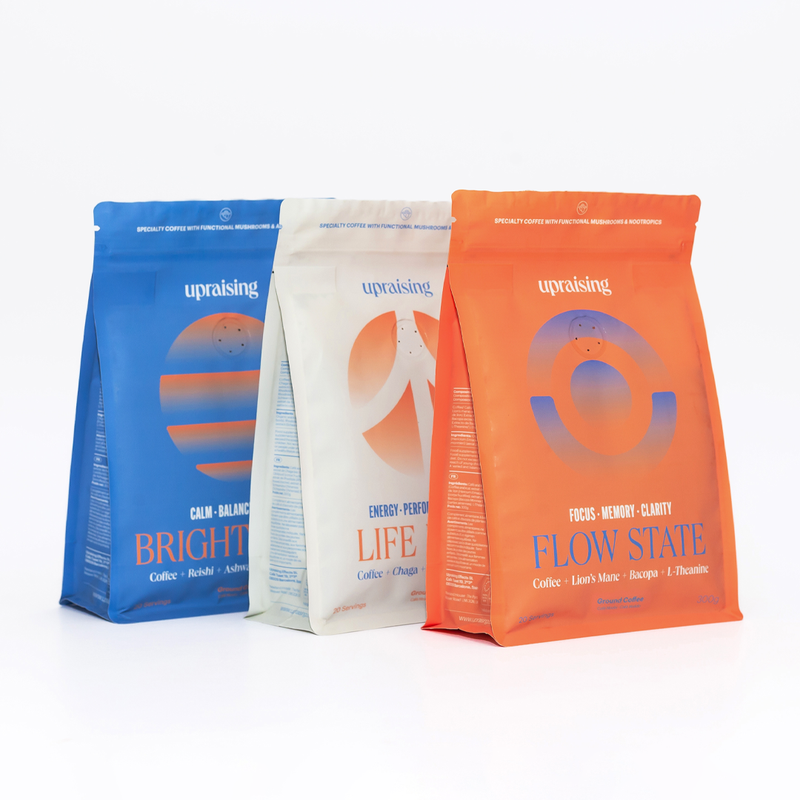
For cognitive longevity specifically, Lion's Mane is relevant because NGF declines with age, and supporting its production may help maintain the integrity of neural connections over time. It is the cornerstone ingredient in Flow State Coffee, paired with Bacopa and L-Theanine for a rounded cognitive support stack.
Bacopa Monnieri

Bacopa Monnieri has been used in Ayurvedic medicine for centuries. The modern research is reasonably strong. At least four randomised controlled trials have found that Bacopa supplementation improves memory formation, reduces the rate of forgetting new information, and supports sustained attention.
Its active compounds — bacosides — protect neurons against oxidative damage and have been shown to inhibit the aggregation of beta-amyloid, the protein implicated in Alzheimer's pathology. This makes Bacopa particularly relevant from a long-term cognitive preservation perspective.
It is worth noting that Bacopa's memory benefits tend to emerge over weeks of consistent use rather than immediately — which fits the approach of consistency over quick fixes.
Ashwagandha (Withania somnifera)

Ashwagandha is one of the most studied adaptogens for stress resilience. Its relevance to cognitive longevity is indirect but significant: chronic stress elevates cortisol, and chronically elevated cortisol damages the hippocampus — a brain region central to memory and learning.
By modulating the HPA axis (the body's stress response system) and reducing cortisol output, Ashwagandha helps protect the brain from one of its most consistent long-term threats. It also improves sleep quality in several trials — which directly supports the brain's nightly maintenance systems. Ashwagandha is a key ingredient in Bright Mood Coffee, alongside Reishi and L-Theanine, for a blend designed around stress reduction and calm focus.
Rhodiola Rosea

Rhodiola Rosea is an adaptogen with a particular affinity for mental fatigue. Research suggests it supports cognitive performance under stress, reduces perceived effort during demanding tasks, and protects against the cognitive cost of burnout.
Mental fatigue is often underestimated as a cognitive longevity risk. Years of operating under chronic stress and depletion take a cumulative toll on neural resources. Rhodiola offers a practical tool for managing this load — supporting day-to-day resilience in a way that matters for the long term.
Reishi (Ganoderma lucidum)

Reishi is best known for its stress-modulating and immune-supporting properties. From a cognitive longevity standpoint, its value lies in reducing neuroinflammation and supporting sleep quality — two of the most important upstream factors in long-term brain health.
Reishi is the functional mushroom at the heart of Upraising's Bright Mood Coffee and the Bright Mood+ Powder, designed for those who want to build these benefits into their routine without coffee.
L-Theanine

L-Theanine is an amino acid found naturally in tea. It promotes a state of calm alertness — it modulates alpha brain waves, reduces anxiety, and, when combined with caffeine, smooths out the jittery edges of stimulation while extending clean focus.
For cognitive longevity, L-Theanine matters because it helps modulate the neurological cost of daily caffeine use — reducing cortisol spikes, supporting better sleep architecture, and allowing the brain to operate in a more sustainable state over time. It appears in both Flow State and Bright Mood coffees for exactly this reason.
How to Build a Cognitive Longevity Routine
The science points to the same conclusion every time: there is no single magic bullet for long-term brain health. What works is a consistent, multi-layered approach — and small daily decisions compounding over months and years.
Here is a practical framework based on the evidence:
Morning
- Move your body — even 20 minutes of brisk walking raises BDNF and sets a positive neurological tone for the day
- Eat a nutrient-dense breakfast — omega-3s, antioxidants, protein
- Consider replacing standard coffee with a functional blend — Flow State Coffee provides Lion's Mane, Bacopa, and L-Theanine alongside your daily caffeine, making cognitive support effortless to maintain

Through the Day
- Engage your brain — read, learn, solve problems, create
- Manage stress actively — short walks, breathing practice, reducing unnecessary demands
- Stay socially connected — conversations, relationships, community
- Hydrate consistently — even mild dehydration impairs cognition
Evening
- Wind down deliberately — the brain needs transition time before sleep
- Protect your sleep window — this is when the real cognitive maintenance happens
- If stress is a consistent issue, an adaptogenic blend like the Bright Mood+ Powder in your evening routine may help support cortisol balance and sleep quality
A Note on Realistic Expectations
Cognitive longevity is not about unlocking superhuman brain performance. It is about maintaining the cognitive function you already have — and building resilience that pays off over time.
The adaptogens and nootropics discussed here are not miracle compounds. They are tools that work best when paired with the foundational habits — sleep, movement, diet, stress management — that underpin everything else.
Consistency is what makes the difference. A daily routine that includes Lion's Mane and Bacopa alongside good sleep and regular exercise is not the same as taking those ingredients occasionally while neglecting the basics.
Long-term brain health is built in the same way as long-term physical health: through small, repeatable actions that accumulate over years. Start with what is sustainable. Build from there.
The Bottom Line
Cognitive longevity is not a luxury concern or a niche interest. It is one of the most important investments you can make — and the best time to start is before you notice any decline.
The evidence is consistent: sleep, movement, diet, stress management, and social connection form the foundation. Targeted adaptogens and nootropics — Lion's Mane, Bacopa, Ashwagandha, Rhodiola, Reishi — support specific biological pathways that underpin long-term brain health when used consistently.
None of this is complicated. It just requires showing up for your brain with the same regularity you would give to anything else worth protecting.
Start with your morning routine. Make it easy to maintain. Give it time to work.